


Views: 0 Author: Site Editor Publish Time: 2026-07-10 Origin: Site


Asian cuisine and fusion restaurants often face a severe operational bottleneck during busy dinner rushes. Manually frying dumplings usually yields highly inconsistent results across different batches. It also requires dedicated, highly skilled labor to constantly monitor standard flat-top grills and adjust temperatures. Moving away from these traditional methods to specialized equipment involves careful, strategic planning. You must accurately evaluate your daily throughput needs, specific kitchen space constraints, and localized utility requirements before making a permanent switch. Without this precise assessment, kitchens risk installing oversized or severely underpowered units. This article provides culinary directors, restaurant owners, and food truck operators with a pragmatic evaluation framework. We will help you systematically shortlist the right cooking equipment. Ultimately, you will successfully match the perfect automated technology to your specific operational scale, menu demands, and available kitchen footprint.
Upgrading to a dedicated dumpling fryer machine reduces labor costs by standardizing the fry-steam-crisp cooking cycle.
Equipment selection depends strictly on footprint (countertop vs. freestanding) and peak-hour production volume.
Heavy-duty stainless steel fryer construction and integrated water drainage are non-negotiable for food safety and operational longevity.
Customizing units via an OEM dumpling fryer manufacturer is a viable path for central kitchens and franchise chains requiring standardized SOPs.
Commercial kitchens face constant, immense pressure to deliver perfect food quickly. Relying on specialized line cooks creates severe vulnerabilities during employee turnover or unexpected sick days. Automated and semi-automated fryers remove this heavy reliance on manual skill completely. They execute a precise fry-steam-crisp cycle automatically without human intervention. We define success in this transition through several non-negotiable criteria.
Identical crust formation across every single batch cooked.
Zero burning or sticking during high-volume dinner rushes.
Consistent internal temperatures reaching legally required safe levels.
Calculating the equipment payback period requires looking closely at labor hours saved. You also must factor in the sheer reduction in wasted or burnt products. A specialized commercial dumpling fryer pays for itself by drastically reducing active prep time. Line cooks can step away to plate other complex dishes while the machine works independently. In a busy kitchen, gaining five extra minutes per cook per hour dramatically improves overall service speed and customer satisfaction.
Furthermore, we must address the reality of cooking frozen products directly. Thawing frozen dumplings presents major food safety risks regarding bacterial growth. It also eats up valuable prep time and cooler space. High-quality commercial units handle frozen products directly from the freezer. They blast intense, targeted heat into the frozen dough immediately. The equipment steams the product rapidly and recovers its baseline temperature almost instantly. This capability completely bypasses lengthy thawing protocols and keeps your inventory perfectly safe.
Different food service models demand completely different equipment footprints. You cannot force a massive industrial unit into a tiny mobile kitchen.
High space-efficiency operations need very compact solutions. Food trucks and small quick-service restaurants often lack expansive ventilation hood space. Countertop units fit perfectly into these cramped environments. They slide neatly onto existing prep tables. However, operators must note critical operational limitations. These units handle much smaller batch sizes, usually capping at twenty or thirty pieces per cycle. Mobile operators also face strict electrical voltage constraints constantly. Choosing between a 110V and a 220V unit requires very careful power load planning. Drawing too much power will trip portable generators during the middle of service.
High-volume dining environments demand serious cooking power and flexibility. Restaurants and catering halls frequently cook several different dumpling varieties simultaneously. Pork, chicken, seafood, and vegetable options need entirely separate handling to prevent allergen cross-contamination. High-capacity freestanding units solve this complex problem beautifully. They feature fully independent temperature controls for each cooking pan. You can stagger your batching effortlessly across different burners. This distinct operational advantage ensures uninterrupted service during chaotic dinner rushes.
Central kitchens manage massive, continuous production lines daily. They supply dozens of franchise locations and retail outlets. Industrial conveyor-style equipment fits this massive scale perfectly. These automated systems move thousands of pieces per hour seamlessly. However, they require heavy capital expenditure upfront. Facilities must install specialized 3-phase industrial power systems to handle the electrical load safely. Complex installation logistics demand professional engineering oversight. You also need dedicated floor zones for automated loading and unloading procedures.
Configuration | Best Suited For | Power Requirements | General Batch Capacity |
|---|---|---|---|
Countertop Single-Burner | Food Trucks, QSRs | 110V / 220V Standard | Low (20-30 pieces) |
Freestanding Multi-Burner | Restaurants, Catering | 220V Single or 3-Phase | Medium (60-120 pieces) |
Industrial Conveyor | Central Kitchens | 3-Phase Industrial | High (Continuous flow) |
Understanding technical specifications prevents costly purchasing mistakes. You must look beyond basic dimensions and aesthetic designs.
The thickness of the cooking plate matters immensely for heating uniformity. Thick metal plates offer superior thermal heat retention. When you drop frozen dumplings onto a thin plate, the surface temperature plummets instantly. A robust cast iron or thick steel plate recovers its heat rapidly instead. This rapid thermal recovery ensures a perfectly crispy, golden bottom every single time. Thin plates lead to pale, soggy wrappers because they boil the dough rather than searing it.
Constant exposure to water, hot cooking oil, and pressurized steam creates harsh environmental conditions. Therefore, choosing food-grade 304 or 316 stainless steel is absolutely mandatory. You must procure a heavy-duty stainless steel fryer body to prevent dangerous rust accumulation. When evaluating materials, remember 304 provides excellent baseline rust resistance. However, if your kitchen relies heavily on acidic marinades or aggressive chemical cleaners, upgrading to marine-grade 316 stainless steel prevents pitting. Superior corrosion resistance extends the lifespan of your kitchen equipment significantly. It also keeps health inspectors satisfied during routine checks.
Let us examine water injection and drainage systems closely:
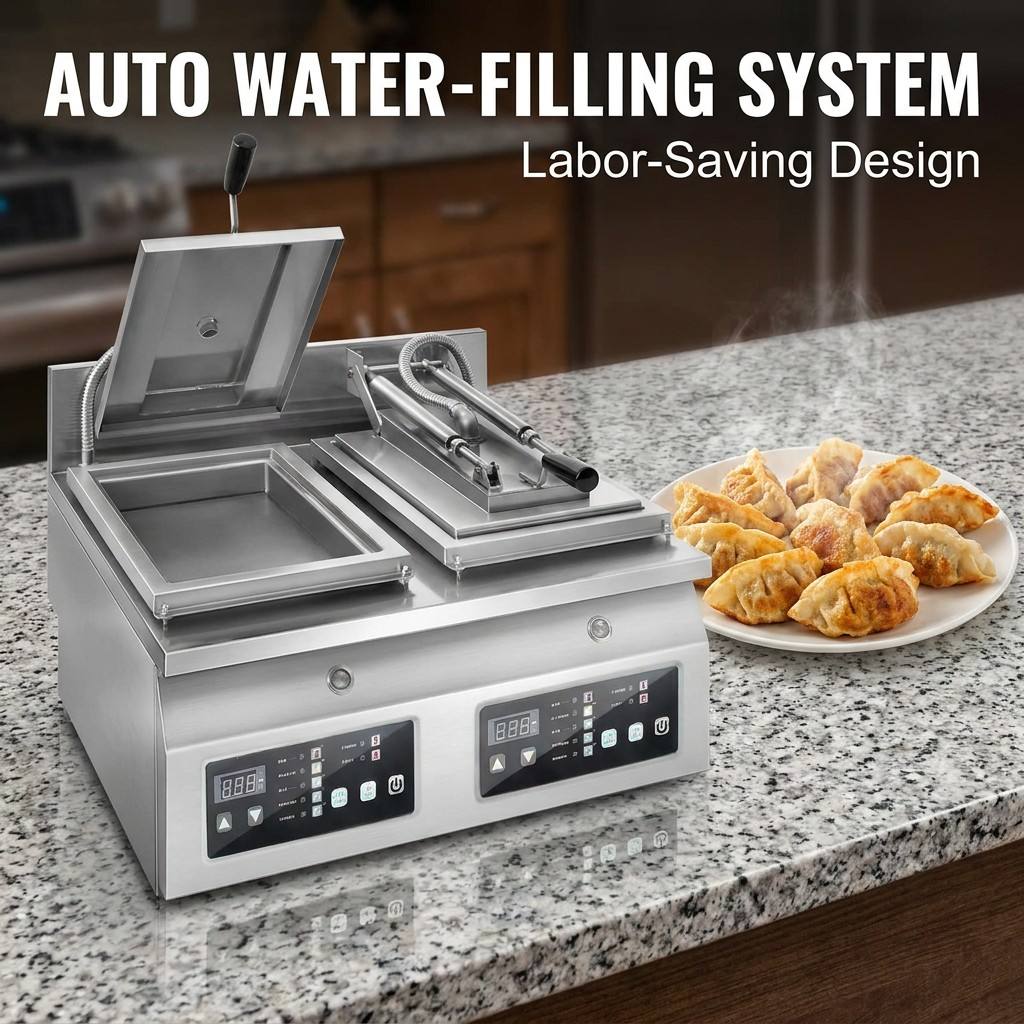
Manual vs. Automatic Water Fill: Manual systems are cheaper upfront and simpler to maintain long-term. However, automatic water injection drastically reduces operator error. The machine adds the exact water volume needed for perfect steaming based on the programmed internal timer.
Drainage Realities: Proper liquid drainage prevents soggy, ruined food. Sloped griddles actively push excess liquid toward front-facing drain valves. This smart design prevents grease and dirty water pooling. It ensures the food crisps beautifully rather than boiling in a murky puddle.
Trapping steam efficiently cooks the wrapper and raw meat filling thoroughly. Heavy-duty, hinged lids lock this hot steam tightly inside the pan. Operators need well-balanced, commercial-grade hinges. A flimsy or overly heavy lid could slam shut unexpectedly and pose severe physical burn risks. High-quality hinges stay safely open while cooks remove the finished food rapidly.
Even the best equipment fails without proper daily maintenance. Kitchens must respect the chemistry of high-heat cooking.
Starch from wrappers and high-heat oil create a stubborn, sticky residue. This mixture quickly polymerizes into a rock-hard carbon layer on your cooking surface. Over time, this thick buildup destroys the non-stick properties of your pan completely. Dumplings will tear open when cooks try to remove them. Kitchens must implement strict, documented daily cleaning procedures. We have seen pristine machines degrade in three months purely due to poor cleaning. Cooks often try to use abrasive steel wool to remove this carbon. Steel wool heavily scratches the cooking surface, which only accelerates future sticking. Instead, operators must boil water in the pan at closing time to loosen debris. They must then use chemical degreasers specifically formulated for hot food-grade surfaces, paired with non-abrasive high-heat scrubbing pads. Skipping this crucial step ruins the expensive equipment rapidly.
Many operators severely underestimate basic utility requirements during initial installation. Plugging a high-draw electric gyoza fryer into a standard wall outlet immediately causes blown electrical breakers. You must verify your specific facility amp draw limits first. Additionally, high-volume water disposal demands highly accessible floor drains nearby. Carrying heavy buckets of greasy wastewater across a busy, slippery kitchen invites terrible slip-and-fall accidents.
Some restaurant owners mistakenly believe enclosed fryers bypass local hood requirements entirely. This assumption is completely false. While the heavy lid traps steam temporarily, the final oil-frying phase generates heavy grease-laden vapors. Local fire and health codes mandate integrating these specific units into standard Type 1 commercial hood systems. Failing this basic mechanical inspection delays restaurant openings by several costly weeks.
Choosing where to buy your equipment dictates your long-term service support and operational flexibility.
Independent, single-location restaurants usually need immediate equipment deployment. Buying an off-the-shelf dumpling fryer machine makes perfect sense here. Standard models ship quickly from warehouse shelves and feature straightforward local warranties. Local service technicians already carry replacement parts for these highly common brands. You avoid long shipping delays if a heating element fails unexpectedly during a busy weekend.
Multi-unit franchises and large food factories possess very different operational needs. They require custom pan sizes to fit proprietary product dimensions perfectly. They also demand specific automation integration to minimize factory labor. Partnering directly with an OEM dumpling fryer manufacturer provides these highly tailored solutions. You can even add custom proprietary branding to the exterior panels for franchise visual consistency. These manufacturers will gladly adapt software timers and water sensors to your exact recipe specifications.
Treat supplier vetting as a critical, long-term business partnership. Ask them very specific questions before signing any purchase orders. Are spare electronic parts readily available in your specific country or region? What are the exact warranty specifics covering internal heating elements versus exterior panels? Do they hold recognized compliance certifications like NSF, CE, or UL? Without these specific safety certifications, local health inspectors might reject your brand-new equipment immediately.
Finding the right cooking unit follows a very straightforward evaluation funnel. First, explicitly define your exact daily volume requirements and peak-hour demands. Next, check your kitchen utility constraints carefully. Look at available electrical amperage limits and physical hood space limitations. Then, choose your ideal configuration between a compact countertop model or a large floor unit. Finally, vet the manufacturer thoroughly regarding warranties and replacement parts.
We highly advise buyers to request detailed engineering spec sheets immediately. Always confirm the exact warranty terms for critical internal components like heating elements. Measure your exact counter depth, width, and hood clearance before signing any procurement documents. These small, deliberate preparations prevent massive installation headaches later. They ensure your kitchen operates at peak efficiency from day one.
A: No. Standard flat-top griddles lack crucial steam-trapping capabilities. They also miss integrated water drainage systems. Without a heavy, sealed lid, steam escapes quickly, leaving fillings undercooked. Furthermore, standard griddles cause water and grease to pool together. This pooling leads to soggy bottoms instead of a perfectly crispy texture. Specialized equipment eliminates these workflow inefficiencies completely.
A: Commercial units typically operate between 150°C and 200°C (300°F to 392°F). The exact temperature depends on the dough thickness and filling type. High-quality machines blast heat into the frozen product instantly. Their thick cooking plates recover this high temperature rapidly after the cold dough hits the surface. This rapid recovery prevents sticking and ensures a golden crust.
A: Not at all. Semi-automated models actually reduce staff training time significantly. You can teach a new hire the basic standard operating procedure in minutes. They simply add oil, drop the product, inject water, and press a timer button. The machine handles the complex timing automatically. This drastically lowers the learning curve for back-of-house staff.
