


Views: 0 Author: Site Editor Publish Time: 2026-06-12 Origin: Site


Commercial sushi and Japanese catering operations frequently face a major bottleneck during peak hours. Labor costs run high in commercial kitchens. Product consistency often wavers during intense dinner rushes. You need a fast, reliable way to output perfectly shaped portions every single time. Transitioning from manual forming to a commercial sushi rice ball machine changes the equation completely. It stabilizes your daily overhead significantly. It also ensures absolute gram-weight precision for every single serving you plate. Chefs no longer spend endless hours rolling rice by hand. Instead, they focus on high-value prep and elegant plating presentations. This guide serves as a pragmatic evaluation framework. We built it specifically for operations managers and restaurant owners. You need a clear way to compare automated solutions. You will learn how to assess throughput and evaluate grain integrity. You will also discover how to choose the right equipment to scale your business efficiently.
Automated equipment reduces labor dependency while guaranteeing strict portion control (gram-weight precision).
Selecting the right rice ball former depends heavily on peak-hour volume requirements (ranging from 800 to 3,000+ balls per hour).
High-end Japanese food machinery protects rice grain integrity (preventing "smashed" texture), a major differentiator from budget alternatives.
Let us examine labor reallocation first. A trained sushi chef commands a premium hourly rate. Paying them to perform repetitive rice shaping wastes valuable kitchen resources. You can redirect this skilled labor to high-margin tasks. They should focus on precision fish slicing. They should handle complex roll construction and beautiful garnish plating. An automated sushi maker machine takes over the tedious foundational work. This shift instantly improves kitchen efficiency. It also boosts team morale by removing mind-numbing repetitive tasks.
Next, consider the quality and consistency matrix. Hand-formed rice balls naturally vary in size. They also vary in density. Human error creates highly inconsistent food costs per plate. One chef might pack the rice tightly. Another chef might leave the grains loose. Machine-formed rice completely eliminates this human variability. Every single piece weighs exactly the same. You standardize food costs across your entire menu. You also deliver a highly predictable eating experience to your customers.
Finally, we must define throughput scalability. Success in the restaurant industry depends heavily on peak service times. A bustling dining room needs maximum table-turnover volume. A machine must handle this peak volume effortlessly. It cannot drop the holding temperature. It cannot compromise on the final shape quality. You need equipment capable of keeping pace during a Friday night rush. If the kitchen falls behind, customer satisfaction plummets. Automation solves this critical service bottleneck.
Labor Optimization: Free up skilled chefs for profitable, creative culinary tasks.
Cost Control: Lock in exact gram weights for precise inventory tracking.
Scalable Output: Meet sudden spikes in weekend demand seamlessly without hiring extra hands.
Let us explore the available equipment categories in detail. Kitchens vary drastically in size and output requirements. You must match the hardware to your specific operational needs.
Best for: Food trucks, small cafes, or low-volume operations.
Limitations: They depend entirely on operator speed. You still need an employee standing there pressing molds manually. They offer minimal impact on major labor costs. They only solve the basic shape consistency problem.
Mechanism: The operator feeds cooked rice into the top hopper. The machine forms the shape internally. It then dispenses single units onto a rotating turntable or holding plate.
Best for: Mid-sized restaurants and delivery-only ghost kitchens. They handle moderate volume exceptionally well. They allow one operator to plate dishes while the machine forms rice automatically. A reliable rice ball former in this category speeds up service significantly.
Mechanism: These units feature continuous hopper feeding. They automatically form the rice portions. They also manage batch tray alignment. The machine lines up perfectly shaped pieces on large catering trays.
Best for: Large-scale catering companies and supermarket commissaries. They also suit high-volume franchise models perfectly. You load the massive hopper and walk away. The machine handles all the heavy lifting.
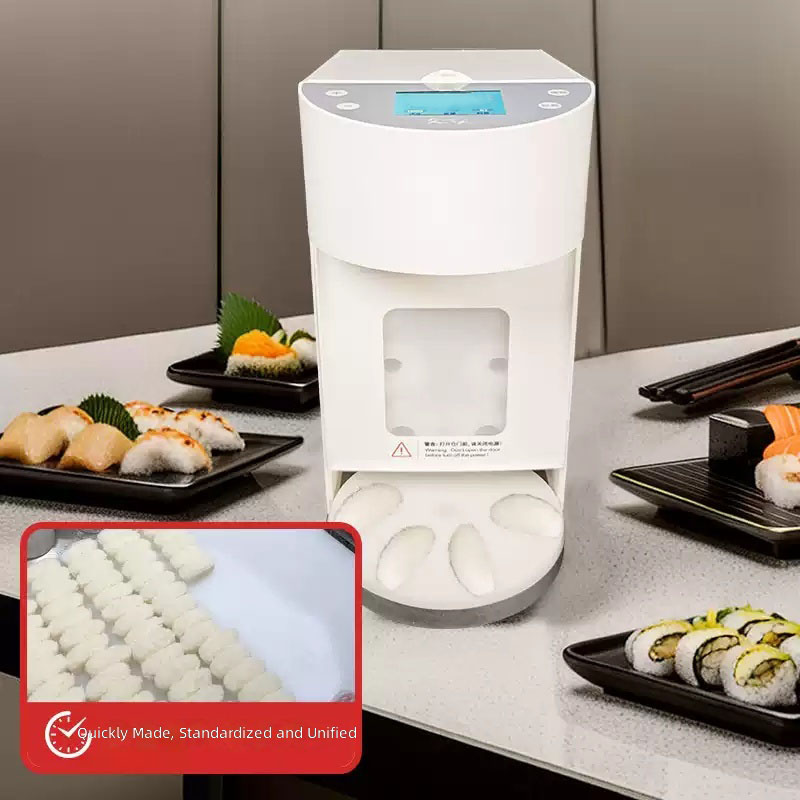
Evaluating commercial kitchen hardware requires close attention to detail. Do not just look at the upfront price tag. Look closely at how the machine handles delicate ingredients. Proper Japanese food machinery treats seasoned rice with immense respect.
Check the internal mechanics carefully. Does the unit use gentle compression? Or does it use aggressive internal augers? Smashed rice grains release excess sticky starch. This starch ruins the shari (sushi rice) texture completely. It makes the final bite gummy and unpleasant. Look for machines advertising "human-touch" forming. Low-impact forming keeps tiny air pockets intact inside the rice ball. This mechanical process mimics a master chef's hands perfectly.
You must match the hopper capacity to the BPH output. Some units boast a massive high BPH, like 3,000. However, they might only feature a small 5kg hopper. A high BPH combined with a tiny hopper creates a workflow disaster. It requires constant manual refilling from your staff. This completely defeats the entire purpose of kitchen automation. Your staff will spend all their shift loading rice.
Operation Size | Ideal Hopper Capacity | Target BPH (Balls Per Hour) | Refill Frequency |
|---|---|---|---|
Small Cafe / Food Truck | 2kg - 5kg | 500 - 800 BPH | Moderate |
Mid-Sized Restaurant | 6kg - 10kg | 1,200 - 2,000 BPH | Low |
Supermarket / Catering | 11kg - 15kg+ | 2,500 - 3,500+ BPH | Very Low |
Restaurant menus change over time. Can the equipment switch between different weights easily? You might need an 18g nigiri today. You might want a 25g nigiri tomorrow. Can it handle triangle shapes and rectangular shapes? Assess the cost of buying proprietary molds. Also, check the physical ease of swapping these molds during a busy lunch shift. Quick-change mechanisms save valuable minutes.
Bringing automation into a kitchen introduces entirely new daily routines. You must prepare your kitchen staff for these operational changes. Proper implementation ensures the equipment runs smoothly for years.
Commercial kitchens operate under strict health department codes. You require NSF, ETL, or UL certifications. Verify these credentials before making any purchasing decision. The equipment must meet local health department regulations. Inspectors will actively check for these badges during routine kitchen visits. Uncertified machines pose a massive regulatory risk to your business license.
Complex machines waste precious time. A machine saves two hours of labor during dinner service. However, it takes 1.5 hours to clean at closing time. This makes it a poor operational investment. Your staff will quickly grow to hate using it.
Look specifically for tool-less disassembly features. You want fewer moving parts overall. Prioritize Teflon-coated components. Non-stick resin parts actively prevent rice adhesion. They wash easily in a standard three-compartment sink. Fast teardown keeps your closing shifts short and efficient.
Temperature control remains vital for sushi rice. Cold rice becomes hard and unappetizing. Built-in hoppers need quality temperature retention. They must keep the seasoned rice at the food-safe, optimal serving temperature. This sits right around body temperature (98°F/37°C). The heater must maintain this precise warmth without drying the rice out. Proper moisture control keeps the grains plump and delicious.
You have many distinct options on the market today. Knowing the difference between manufacturing tiers helps you choose wisely. You need onigiri equipment matching your specific business model.
Well-known Japanese engineering brands dominate the high-end market.
Pros: These units offer proven operational longevity. They provide superior grain preservation technology. They hold remarkably high resale value. You also get highly reliable US/EU parts networks.
Cons: They require a substantial upfront capital expenditure.
Generic brands flood online marketplaces. They target tight budgets.
Pros: They present a very low barrier to entry. They work reasonably well for proof-of-concept testing in new kitchens.
Cons: You face highly questionable warranty support. You risk inconsistent mold sizes out of the box. They often lack commercial sanitation certifications entirely.
Many operators look closely at refurbished models. If you evaluate used equipment, emphasize checking the specific condition of the Teflon coating. Scratched Teflon causes severe rice sticking issues. Also, check the availability of replacement optical sensors. Older models might use discontinued electrical components. You do not want a broken machine waiting weeks for overseas parts.
Machine Category | Best Use Case | Common Pitfalls to Avoid |
|---|---|---|
Premium Brands | High-volume, fine dining, scaling franchises | Underutilizing the capacity; failing to train staff properly. |
Budget Models | Pop-up events, menu testing, extremely low volume | Failing health inspections due to lack of NSF/UL certs. |
Refurbished/Used | Mid-sized cafes looking for premium features on a budget | Buying units with badly degraded non-stick resin parts. |
Upgrading to a commercial automated system represents a major operational step. It is fundamentally a capacity and consistency decision. It is not just a standard kitchen hardware purchase. It completely redefines your daily workflow. You eliminate human error while drastically speeding up service times.
Follow these action-oriented next steps:
Calculate your daily rice ball volume carefully before browsing catalogs.
Audit your kitchen prep space for physical footprint constraints.
Request a hands-on demo from the equipment manufacturer.
Demand video proof of the machine handling your specific recipe of seasoned rice before purchasing.
A: Typically 20 to 45 minutes. This depends heavily on the model's complexity. Look for units featuring tool-less, washable resin parts to keep cleaning times closer to the 20-minute mark.
A: High-end commercial models use specialized gentle-compression molds. These are designed specifically to mimic a chef's hands, preserving the delicate air pockets. Budget models, however, may compress the rice too tightly.
A: Usually no. While some machines have interchangeable molds for different sizes of nigiri, the fundamental forming mechanism for a 20g nigiri differs greatly from a 100g stuffed onigiri. Specialized equipment is typically required for each category.
A: Around 37°C (98°F). Look for machines featuring heated hoppers. This prevents the rice from cooling and hardening during service, which causes severe internal jamming.
