


Views: 0 Author: Site Editor Publish Time: 2026-06-13 Origin: Site


Transitioning from small-batch nut roasting to automated production marks a critical milestone for your food business. You face intense new demands for volume, speed, and precision. Scaling a nut roasting operation introduces unique engineering challenges. You must balance batch consistency, energy efficiency, and high throughput perfectly. Choosing incorrect hardware leads to uneven roasts, wasted utility expenses, and frustrating operational bottlenecks.
We provide an objective framework for evaluating, shortlisting, and procuring commercial and industrial-grade equipment. You will learn how to assess heating methodologies clearly. We show you how to match machine capacities to your actual production yields accurately. You will also discover how to navigate complex facility installation requirements. This guide empowers you to make a confident, data-driven equipment upgrade.
Capacity Alignment: True production yield often falls 15-20% below theoretical machine limits depending on target roast depth and initial moisture content.
Heating Source Economics: The choice between electric and gas models dramatically impacts both upfront infrastructure costs and long-term operational margins.
Automation vs. Control: Continuous roasting equipment suits high-volume standardization, while commercial drum roasters offer necessary thermal control for specialty batches.
Total Cost of Ownership: Procurement should factor in ventilation compliance, maintenance downtime, and replacement parts, not just the initial purchase price.
Before contacting suppliers, you must accurately define your production demands. Misjudging your required capacity often leads to severe operational bottlenecks. We categorize equipment into two distinct tiers based on duty cycles and throughput expectations.
You need to establish a clear production baseline. Retailers, artisanal brands, or low-to-medium volume operators usually rely on standard commercial units. These machines typically handle 10kg to 50kg per batch. They require frequent manual intervention but fit comfortably into smaller kitchen spaces.
Operators targeting massive daily quotas require a significant upgrade. A true peanut roasting machine industrial setup handles high-throughput, continuous duty cycles. Engineers design these robust machines to operate uninterrupted for multiple shifts. They integrate seamlessly into larger food processing machinery lines, connecting directly to cooling carts, destoners, and seasoning drums.
Selecting the right processing style dictates your product flexibility and labor requirements. Operators generally choose between batch drum systems and continuous conveyor systems.
Batch Drum Roasters: These units remain the industry standard for multi-product flexibility. They allow operators to adjust roast profiles manually for different premium nuts. You gain extremely tight quality control over each specific batch. They suit businesses processing smaller runs of specialized flavors.
Continuous Roasters (Conveyor/Belt): Facilities prioritizing massive single-product lines rely on continuous systems. Raw peanuts enter one end, and perfectly roasted products exit the other constantly. They deliver standardized roast profiles without manual intervention. You sacrifice some flexibility but gain unparalleled daily output.
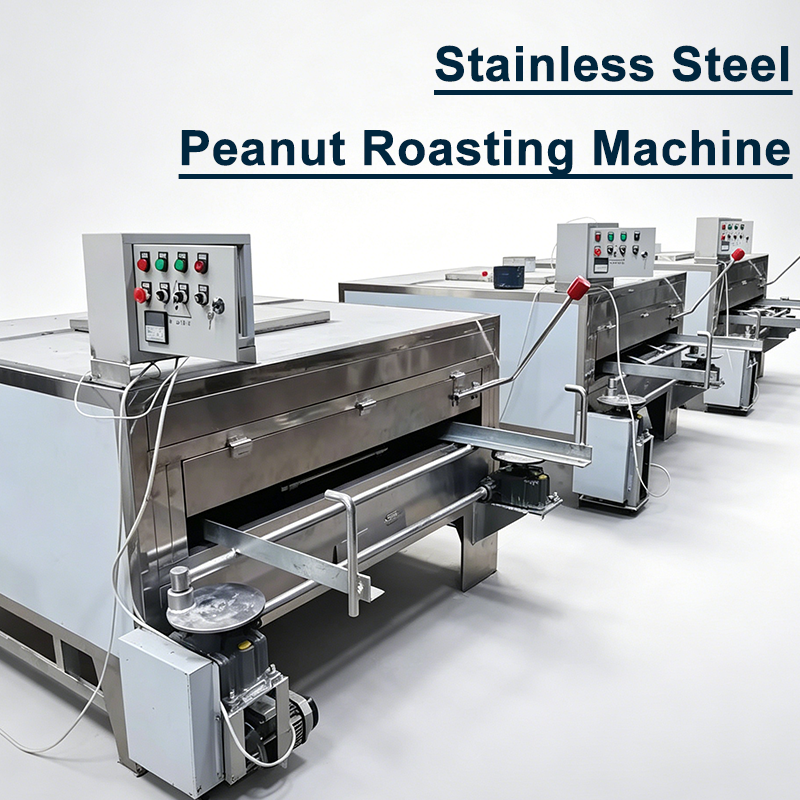
Procurement teams must evaluate several critical dimensions when selecting a commercial roaster. You must look beyond simple price tags and examine heating methodology, material construction, and thermodynamics.
Your choice of heating source fundamentally alters your facility requirements. Manufacturers offer distinct electrical and gas-powered configurations.
Feature | Electric Roasters | Gas Roasters (Natural Gas/LPG) |
|---|---|---|
Temperature Control | Highly precise, digital modulation. | Excellent, though requires careful burner tuning. |
Installation Complexity | Lower complexity. Zero direct emissions. | High complexity. Needs robust gas lines and flues. |
Scalability Constraints | Often limited by the local electrical grid capacity. | Highly scalable for massive industrial operations. |
Operational Efficiency | Can be expensive depending on local power grids. | Generally offer superior thermal efficiency at scale. |
Electric models provide exceptional precision. They simplify installation because they produce zero direct combustion emissions. However, industrial-scale electric heaters draw massive amperage. Your local electrical grid might restrict your ability to scale operations efficiently.
Gas roasters utilize Natural Gas or LPG. They demand higher upfront installation efforts. You must route industrial gas lines and install strict ventilation flues. Despite these hurdles, gas combustion generally delivers superior thermal energy transfer. This efficiency usually results in lower operating costs for massive processing plants.
Food safety regulations dictate stringent material requirements for processing equipment. You must protect consumers from contamination and heavy metal exposure.
Mandate High-Grade Steel: Specify strictly 304 or 316 stainless steel for all food-contact surfaces. These grades resist corrosion from salt, oil, and intense heat perfectly.
Sanitization Access: Evaluate the internal design carefully. Look for wide access doors, removable drip trays, and easily detachable conveyor belts.
Cross-Contamination Prevention: Quick sanitization prevents allergen cross-contamination. This feature proves critical when switching lines between different nut varieties.
Heat application dictates flavor development and visual appeal. A versatile nut roaster utilizes specific airflow and heat transfer mechanisms.
Analyze how the machine distributes energy. Older models rely heavily on conduction via direct drum contact. This method often risks surface scorching before the core cooks properly. Modern systems prioritize forced convection. They push superheated air through the tumbling product mass actively. Convection limits aggressive surface burning and ensures highly uniform core temperatures across the entire batch.
Facility managers frequently underestimate the logistical footprint of large machinery. You must align the machine's technical specifications with your factory's actual spatial and infrastructural realities.
Manufacturers list theoretical maximum capacities under perfect laboratory conditions. You will rarely achieve these exact numbers on a bustling factory floor. You must calculate realistic yields based on multiple dynamic factors.
Raw peanut moisture levels heavily influence your final output weight. Peanuts entering the chamber at 8% moisture and leaving at 2% lose significant mass. Furthermore, operators lose time during loading and unloading cycles. A machine rated for 500kg per hour might only yield 410kg of salable product. Always avoid under-sizing your equipment. Factor in a minimum 20% growth buffer when selecting hopper and drum capacities initially.
Heavy machinery requires substantial infrastructural support. You cannot simply plug these units into standard wall outlets or place them in confined corners.
Power Requirements: Industrial motors, heavy-duty blowers, and electric heating elements demand dedicated three-phase power connections. Ensure your facility electrical panels can handle sustained high-amperage draws safely.
Ventilation and Exhaust: Nut roasting generates substantial byproducts. You must size industrial exhaust systems to handle thick smoke, flying chaff, and heavy oil particulates safely. Undersized exhaust fans lead to dangerous facility air quality and frequent fire hazards.
Floor Space: Never measure just the machine dimensions. You must account for the entire operational ecosystem. Allocate adequate floor space for loading bucket conveyors, massive cooling carts, and wide maintenance clearances. Technicians need room to swing open heavy access panels safely.
Acquiring heavy processing hardware involves significant implementation hurdles. Managers must anticipate installation challenges, ongoing maintenance demands, and baseline energy consumption metrics to guarantee smooth operations.
The commissioning process introduces several logistical challenges. You will face heavy freight and specialized rigging fees. Riggers must maneuver massive steel frames into place safely. Installation frequently demands comprehensive electrical upgrades and complex ductwork routing.
Furthermore, you must secure local safety certifications aggressively. Depending on your region, you might need CE marking, UL listing, or immediate local fire marshal approval. Failing to secure these permits delays production schedules severely.
Continuous production environments punish mechanical components relentlessly. Proactive maintenance prevents catastrophic production delays.
Identify high-wear components early. Heating elements eventually degrade. Drive belts snap under constant tension. Sensitive thermocouples lose calibration over time. You must prioritize manufacturers offering highly transparent spare parts availability. Seek out modular machine designs deliberately. Modular engineering allows your in-house maintenance crew to swap broken parts swiftly without waiting for external specialists.
Thermal loss drains facility resources quickly. You must assess insulation quality rigorously before finalizing your purchase.
Check the specified rock wool insulation thickness wrapping the roasting drum. High-quality insulation minimizes ambient heat loss directly into your factory floor. Poorly insulated machines force your facility HVAC systems to work exponentially harder to cool the room. Superior thermal retention keeps utility bills lower and maintains comfortable working conditions for your operators.
Procuring capital equipment requires a structured, skeptical approach. You must validate vendor claims systematically before transferring substantial funds.
Never accept glossy marketing brochures at face value. Request hard, empirical data from the engineering team. Ask for detailed charts outlining exact heat-up times from a cold start. Demand metrics showing thermal recovery speeds after operators load a cold batch of peanuts. You also need verified data detailing the precise energy consumption required per kilogram of processed material.
Protect your investment through rigorous pre-shipment testing. Implement these verification steps:
Demand a Factory Acceptance Test (FAT): Require the manufacturer to run the machine fully assembled on their floor before crating it.
Supply Your Own Raw Materials: Ship a pallet of your specific raw peanuts to the factory. Different nut densities roast differently.
Analyze the Output: Inspect the roasted samples for color consistency, core crunch, and exact moisture reduction.
Verify the Throughput: Time the production run to ensure it meets the promised kilograms-per-hour metric.
Industrial warranties vary wildly between suppliers. You must differentiate between comprehensive operational warranties and basic parts-only guarantees. A parts-only guarantee leaves you paying expensive hourly labor rates for technicians.
Establish strict Service Level Agreements (SLAs) for technical support. This step proves absolutely critical when importing equipment globally. You need guaranteed response times, remote troubleshooting availability, and rapid international shipping commitments for critical replacement parts.
Evaluating raw specifications is only the first step. You must successfully integrate this complex machinery as a reliable node within your broader production line. Careful analysis separates highly profitable operations from frustrating, bottlenecked factories.
Remember that the best machinery matches your specific facility constraints and operational goals perfectly. Do not simply default to purchasing the unit boasting the highest stated capacity. A massive machine choking on inadequate facility ventilation serves no purpose.
We highly recommend standardizing your internal requirement document first. Define your required capacity, available three-phase power, and preferred heating type clearly. Present this standardized data to vendors when requesting quotes. This structured approach guarantees accurate proposals and ensures a highly successful equipment upgrade.
A: Standard baking ovens rely on static heat. Roasting machinery features continuous product agitation using rotating drums or moving belts. They also utilize high-convection forced airflow. This combination ensures dynamic, even roasting across every single nut, preventing the localized burning common in static ovens.
A: Yes. Most modern drum and continuous systems handle diverse products easily. They process almonds, cashews, sunflower seeds, and coffee beans successfully. You simply need to adjust the digital temperature setpoints, airflow dampeners, and mechanical rotation speeds to match the new product profile.
A: Roasted peanuts require immediate, rapid ambient cooling to halt the internal roasting process. Dedicated cooling trays, airflow carts, and exhaust ducting usually require floor space equal to or greater than the roaster itself. Always double your spatial footprint estimates.
A: Electric units offer easier, cleaner installation. However, gas-powered systems generally provide a significantly lower cost-per-kilogram at massive industrial volumes. Your exact cost-effectiveness depends entirely on your regional commercial utility rates for gas versus electricity.
