


Views: 0 Author: Site Editor Publish Time: 2026-06-15 Origin: Site


Transitioning from packaged snacks to fresh produce completely changes the vending game. You want to capture the high margins of premium, on-the-go health drinks. Consumers eagerly pay top dollar for unpasteurized, freshly squeezed citrus. However, raw fruit logistics present a massive operational hurdle. Operators must balance strict machine maintenance against hardware reliability daily. Perishable goods demand absolute precision.
We designed this article to provide a rigorous, hype-free framework. You will learn how to evaluate, source, and successfully operate an automated citrus setup. We strip away the marketing fluff. Instead, we focus on the raw metrics dictating profitability. You will discover how to assess extraction hardware, manage sanitation compliance, and integrate vital software. Let us dive into the operational realities of fresh produce automation.
**Profitability hinges on yield and uptime:** The viability of an orange juice vending machine depends strictly on extraction efficiency (juice per orange) and minimizing out-of-order states.
**Maintenance is the primary operational bottleneck:** Unlike standard vending equipment, fresh juice dispensers require stringent daily cleaning and waste management to meet health compliances.
**Smart telemetry is non-negotiable:** Real-time inventory tracking and cashless payment integrations are mandatory for managing perishable stock effectively.
**Hardware dictates scale:** Evaluation should prioritize hopper capacity, internal refrigeration, and heavy-duty extraction components over purely aesthetic features.
Selling fresh citrus demands a completely different strategy than selling canned soda. You deal with short shelf lives and premium price points. Success requires precise placement and a clear understanding of daily costs.
You cannot place these units in low-traffic areas. They require high baseline foot traffic and specific demographic profiles. Consumers must have disposable income and prioritize health. You must justify the larger footprint and higher capital expenditure.
Airports: Travelers want quick, healthy refreshment. They easily accept premium pricing.
Corporate Campuses: Office workers seek midday health boosts. These locations provide consistent daily volume.
Premium Fitness Centers: Gym members want immediate post-workout nutrition. Fresh citrus aligns perfectly with fitness goals.
Hospitals: Visitors and staff need healthy, 24-hour options. Traditional snacks often fail to meet these dietary preferences.
Consumers willingly pay a premium for on-demand, unpasteurized drinks. They enjoy the visual theater of the squeezing process. This theater drives impulse purchases. However, you face a harsh operational reality. Frequent restocking becomes mandatory. Fresh fruit spoils quickly if left unmonitored. You must balance the high retail price against elevated spoilage risks. A single batch of bad fruit ruins consumer trust.
Profitability depends on a tight formula. You must weigh daily operational expenses against your average daily vends. You cannot just look at the raw fruit cost. You must factor in route logistics.
ROI Calculation Variables Chart | ||
Variable Category | Specific Components | Impact on Margins |
|---|---|---|
Raw Goods | Oranges, cups, lids, sealing film | Directly reduces gross profit per vend. Bulk purchasing lowers this cost. |
Utilities | Electricity (refrigeration, extraction motors) | Fixed daily cost. Highly efficient compressors minimize impact. |
Labor Logistics | Cleaning time, restocking frequency | Highest hidden cost. Frequent visits destroy route profitability. |
Revenue | Average daily vends × Price per cup | Must exceed the combined daily operational costs to achieve ROI. |
You must scrutinize the internal mechanics. A sleek exterior means nothing if the internal components fail under pressure. Operators need reliable hardware built for high-volume environments.
You must assess the squeezing mechanism carefully. The industry primarily uses either rotary extraction or direct press systems. Rotary mechanisms pull the fruit down, slice it in half, and ream the flesh. This avoids pressing the peel. Direct presses often squash the entire fruit. Pressing the peel releases bitter essential oils. These oils severely contaminate the taste. You want a commercial juicer that guarantees a clean, sweet extraction.
Analyze the yield parameters closely. How many average-sized oranges does it take to fill a standard cup? Most units require three to five oranges. A mere 5% drop in extraction efficiency dramatically impacts your long-term margins. Over ten thousand vends, wasted juice equals thousands of lost dollars.
You must evaluate the internal load limit. A standard hopper holds between 40kg and 50kg of fruit. This capacity directly correlates to labor costs. A small hopper forces your route drivers to visit the machine daily. A larger hopper allows for bi-daily or tri-daily visits. Maximizing capacity reduces restocking trips.
Refrigeration systems keep the product safe. You need programmable, multi-zone cooling systems. The upper zone keeps raw fruit fresh. The lower zone serves the dispensed liquid at optimal temperatures. Proper cooling extends shelf life and ensures food safety. Investing in a reliable orange juice vending machine with robust thermal management is crucial for premium locations.
Cloud-based inventory management transforms route planning. You cannot afford to send drivers to a full unit. You also cannot leave an empty unit offline. Smart software alerts operators to low fruit levels. It warns you about full peel waste bins. It flags technical faults immediately.
Payment flexibility drives sales. Consumers rarely carry cash. Compatibility with universal cashless readers is mandatory. Your unit must accept NFC, RFID, credit cards, and mobile wallets. Seamless transactions increase daily vend volume. Modern vending equipment relies heavily on frictionless payments.
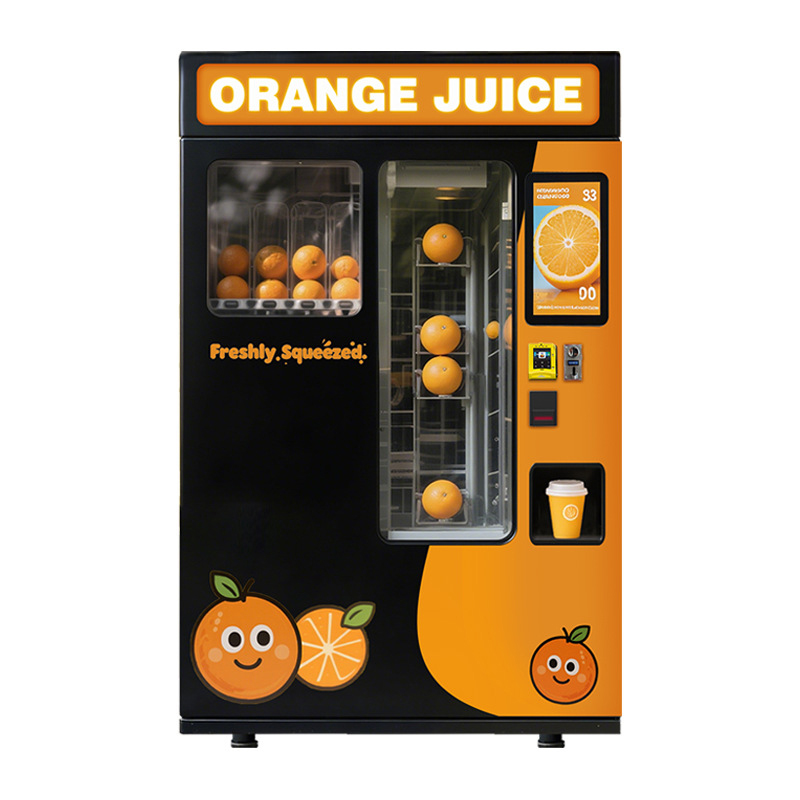
Hardware buys you the capability, but daily operations dictate your success. Perishable food automation requires rigorous discipline. You cannot treat these units like standard snack boxes.
Sanitation represents the most common failure point for operators. Fructose acts like glue. It coats the internal tracks and blades. If left uncleaned, mold develops within 24 hours. You must implement strict daily cleaning protocols. Some high-end units feature "Clean-in-Place" (CIP) systems. These systems utilize automated flushing to clean the extraction zones. However, many units still require manual disassembly. Your route drivers must remove, wash, and sanitize the squeezing components by hand. Choosing a low-maintenance juice dispenser greatly reduces labor friction.
Squeezing citrus generates massive amounts of organic waste. Peels and pulp accumulate rapidly inside the cabinet. You must manage this accumulation to prevent severe issues. Fruit fly infestations ruin a location's reputation instantly. Bacterial growth creates foul odors. Evaluate units equipped with automatic self-sealing waste bags. High-capacity bins with ozone generators also help neutralize odors. Waste management logistics often dictate your actual visitation schedule.
You dispense an unpasteurized beverage. This triggers intense regulatory scrutiny. You must navigate FDA, NSF, or local health department regulations. Inspectors will check internal temperatures. They will review your daily sanitation logs. They ensure the machine blocks access if cooling fails. Non-compliance results in immediate shutdown. Always verify local health codes before deploying a unit.
Choosing the right manufacturing partner secures your investment. A cheap initial price tag often hides massive downstream headaches. You must demand accountability from your supplier.
Standard commercial warranties often prove insufficient. They might cover basic defects but ignore wear-and-tear components. You need guaranteed Service Level Agreements (SLAs) for replacement parts. Heavy usage destroys motors over time. Acidity dulls extraction blades. Plexiglass shields get scratched or cracked. You must secure a fresh juice machine from a supplier who stocks parts locally. Waiting weeks for an imported motor kills your revenue.
The market floods with unbranded, imported dispensers. Purchasing from white-label distributors carries heavy risks. These sellers often lack localized technical support. They abandon you when software glitches occur. We strongly recommend partnering with established B2B brands. Established OEMs provide engineering schematics. They offer dedicated troubleshooting hotlines. They update their telemetry software regularly. Reliability always outpaces initial cost savings.
You mapped your business case. You understand the hardware requirements. Now, you must execute a methodical purchasing process. Follow these exact steps to finalize your shortlisting.
Conduct a site audit: Never buy hardware before checking the location. Verify the electrical load capacities first. Fresh citrus units draw significant amperage during extraction. Check dimensional constraints. Ensure ADA compliance for screen height. Determine the proximity to water sources if you plan to utilize CIP plumbing.
Request live yield demonstrations: Do not rely solely on manufacturer spec sheets. Ask the supplier to run ten cycles live. Weigh the input fruit. Measure the output liquid. Calculate the exact extraction rate yourself. Watch for peel oil contamination during the test.
Audit the software: Hardware requires software to function efficiently. Test the backend telemetry dashboard personally. Evaluate the user experience. Check the reporting granularity. Ensure it exports data seamlessly. Ask about API integration capabilities for your existing route management tools.
Success in the fresh citrus vending sector relies heavily on logistics and maintenance. It goes far beyond a simple hardware purchase. You must manage perishable inventory flawlessly. You must prioritize sanitation daily.
We recommend prioritizing high-grade juicers backed by strong local support. Transparent telemetry yields the highest long-term profitability. It keeps your drivers efficient and your machines online.
Finalize your site agreements first. Secure a consistent, high-quality citrus supplier. Once your supply chain and locations are locked, deploy your capital on machinery. This calculated approach ensures sustainable, high-margin revenue.
A: It typically takes 3 to 5 oranges to produce an 8 to 10-ounce cup. The exact number depends heavily on the fruit's caliber, juiciness, and the machine's internal extraction rate. Highly efficient units extract more liquid, requiring fewer oranges per vend.
A: They require strict daily cleaning. Fructose buildup causes rapid mold growth. Machines with automated Clean-in-Place (CIP) systems flush the lines automatically, but manual models require drivers to disassemble and sanitize the internal squeezing components every 24 to 48 hours.
A: Yes, but within strict limits. Most machines require specific fruit calibers (typically 65mm to 80mm in diameter). You must calibrate the internal tracks to match the fruit size. Mixing vastly different sizes causes severe jamming and mechanical faults.
A: A high-quality commercial unit typically lasts 5 to 7 years. Lifespan depends entirely on maintenance frequency and daily vend volume. Regularly replacing worn blades and keeping the motors clear of sticky residue significantly extends operational longevity.
