


Views: 0 Author: Site Editor Publish Time: 2026-06-10 Origin: Site


Reliable ice production serves as a critical operational safeguard for any food and beverage enterprise. It functions as much more than a standard utility. A failing machine disrupts customer service instantly. It damages beverage profit margins. It also poses serious health compliance risks. You need consistent output to keep daily operations running smoothly. Sourcing an ice maker machine commercial unit requires careful planning. You must align your daily yield, ice type, and cooling technology carefully. These factors must match your specific facility constraints perfectly. Peak-hour demands dictate the exact specifications you need to succeed.
This guide provides a structured framework for evaluating high-capacity equipment. We will explore installation realities and verifiable output specifications thoroughly. You will learn how to accurately size your unit. We will help you select the ideal cooling architecture. You will discover practical methods to mitigate installation risks. We also detail the preventative maintenance steps required to extend equipment lifespan. Read on to master the complexities of industrial ice production.
Yield vs. Storage: A 500-lb daily production rating assumes ideal ambient conditions; actual yield requires factoring in kitchen temperatures and bin storage capacity for peak hours.
Cooling Systems Matter: Air-cooled units cost less upfront but require clearance and raise room temperatures, while water-cooled units are quieter but significantly increase water utility costs.
Utility Prerequisites: Commercial ice machines mandate dedicated electrical circuits, floor drains (often gravity-fed), and strict water filtration to maintain warranty and ensure food-grade output.
Total Cost of Ownership (TCO): Sticker price represents only a fraction of the cost; bi-annual descaling, filter replacements, and energy efficiency dictate long-term ROI.
Getting the equipment size right solves major operational problems. Undersizing leads to expensive emergency ice purchases during busy weekend shifts. You might send staff to local stores just to survive dinner service. Oversizing wastes costly electrical energy. It consumes excess water daily. It also eats up highly valuable floor space. You must balance daily production capabilities against your actual usage patterns. Finding the sweet spot ensures maximum operational efficiency.
Determining your exact daily requirement represents the vital first step. Industry benchmarks help establish accurate baseline targets. They vary heavily based on your specific facility type.
Restaurants: Plan for 1.5 lbs per seat daily.
Hospitals: Allocate 3 lbs per bed daily.
Cocktail Bars: Expect 3 lbs per patron daily.
Hotels: Provide 5 lbs per room daily.
However, implementation realities often differ greatly from marketing brochures. Manufacturers use the "70/50 rule" to rate machine production. They test machines in 70°F ambient air. They use 50°F incoming water. A 90°F kitchen environment alters these numbers dramatically. Hot summer days impact performance heavily. High ambient temperatures can drop actual yield by up to 20%. Warm incoming water slows down the freezing cycle further. You must oversize your target production intentionally. This compensates for hot commercial kitchens. It guarantees you meet demand during challenging environmental conditions.
You must understand the critical difference between 24-hour production and bin capacity. A machine might produce 500 lbs a day. It cannot store that much without an adequately sized bin. Production happens slowly over 24 hours. Your usage spikes drastically during a three-hour dinner rush. You need a large bin to survive these sudden rush periods.
Sizing bins correctly requires basic math. Bins should hold at least 50% of your daily required volume. If you use 600 lbs daily, your bin must hold 300 lbs minimum. This buffer ensures you never run out during peak hours. Nighttime production fills the bin while the restaurant sleeps. You then drain it rapidly during service. A large bin acts as an essential insurance policy. It protects your beverage service from sudden interruptions.
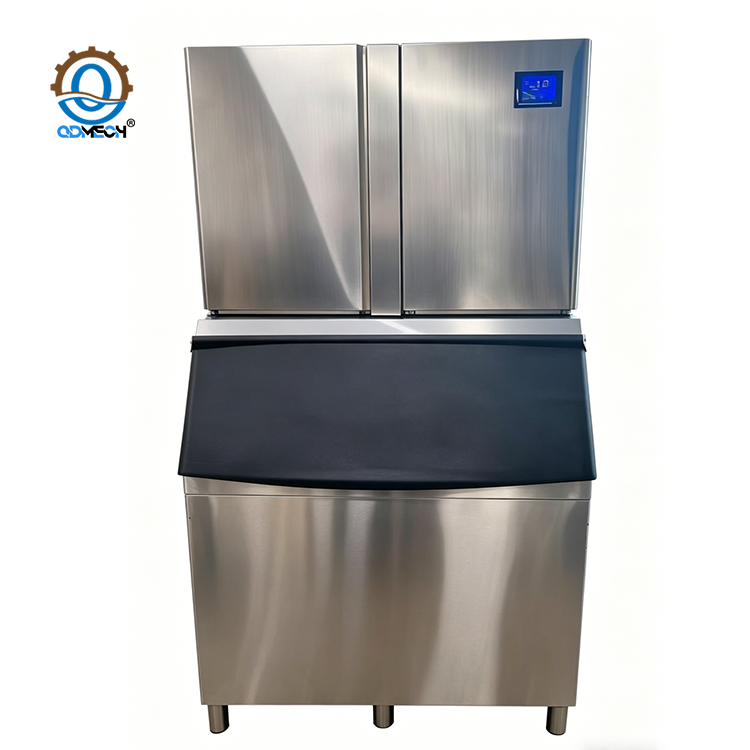
Selecting the right compressor cooling method is vital. An industrial ice maker relies on efficient heat removal to function properly. We can compare the three primary architectures available today to find your best fit.
Air-cooled models offer the easiest overall installation process. They provide the lowest ongoing utility cost. They do not use extra municipal water for cooling purposes. You simply plug them in and connect the water line.
Pros: Simple setup routines. Lower monthly water bills. Wider model availability.
Cons: They require six or more inches of clearance for proper airflow. They eject hot air directly into the kitchen. You must clean the condenser coils frequently. Grease and dust choke the system quickly.
Water-cooled systems remain largely unaffected by hot ambient air. They offer much quieter daily operation. They perform exceptionally well in tight, poorly ventilated spaces.
Pros: Consistent ice production regardless of room temperature. Quiet running noise. Very compact footprint capabilities.
Cons: They consume massive amounts of water daily. Many municipalities restrict or ban them entirely. Environmental regulations often target their high water waste.
Remote setups move the heat and noise entirely outside the building. The ice machine sits indoors while the condenser sits on the roof.
Pros: Zero heat added to the indoor kitchen space. Nearly silent indoor operation. Highly efficient cooling in all seasons.
Cons: They require the most expensive upfront investment. You must route complex refrigerant lines through walls. Roof-mounting logistics add significant installation challenges and labor costs.
Chart 1: Cooling Architecture Comparison | |||
Cooling Type | Best Environment | Primary Advantage | Primary Disadvantage |
|---|---|---|---|
Air-Cooled | Well-ventilated areas | Low water utility cost | Requires clearance, adds heat |
Water-Cooled | Hot, tight spaces | Quiet, immune to hot air | Extremely high water usage |
Remote Condenser | Large facilities | No indoor heat or noise | Complex, costly installation |
You must evaluate ice shape against your core operational goals. Consider the melt rate carefully. Think about liquid displacement in the glass. Choosing the right cube ice equipment directly impacts your beverage quality and profit margins.
Full cubes feature a high surface-to-volume ratio. They look impressive in a glass. They melt very slowly. This makes them ideal for premium spirits. Bartenders prefer them for high-end cocktails. They keep drinks colder longer. They prevent rapid dilution from ruining the flavor profile. They also work perfectly for bagging applications.
The half-cube remains the absolute commercial standard. You see it across most restaurants and fast-food chains. It packs tightly into various glass shapes. This dense packing reduces liquid pour costs significantly. Less liquid fits in the glass when ice fills the voids. It also blends easily in frozen drinks. Blender blades crush half-cubes effortlessly.
Safety regulations mandate strict sanitation standards globally. A true food grade ice maker features specialized antimicrobial components built in. Look for Agion-treated plastics inside the entire food zone. These materials inhibit dangerous bacterial growth. You also need automated purge cycles. These cycles flush out mineral impurities automatically. Ensure your unit carries NSF and ETL sanitation certifications. These badges guarantee the machine meets strict public health safety standards. Health inspectors will check for these specific compliance marks.
Purchasing the right machine represents only half the battle. Proper site preparation dictates a truly successful deployment. Implementation risks can ruin a brand-new machine quickly. You must audit your facility before the delivery truck arrives.
Commercial units carry strict, non-negotiable plumbing requirements. You must use floor drains rather than wall drains. Ice machines rely on gravity-fed systems to purge water. Wall drains cannot handle this gravity flow effectively. Pumping water upward causes frequent mechanical failures. You must also include proper air gaps in the drain line. Air gaps prevent backflow contamination. They stop dirty sewer water from entering the clean ice bin. Health departments strictly enforce proper air gap installations.
Power requirements scale directly alongside production capacity. High-capacity units producing 400+ lbs usually require 220V or 240V dedicated circuits. Do not assume a standard 115V wall outlet will suffice. Sharing a circuit causes tripped breakers. Tripped breakers stop production completely. Check the manufacturer spec sheet early. Hire an electrician to install a dedicated line before scheduling machine installation.
Machines need adequate breathing room to function properly. Inadequate airflow restricts the internal cooling process. This starves the machine of fresh air. It quickly voids manufacturer warranties. It also burns out expensive compressors prematurely. Follow the manufacturer guidelines strictly for minimum side and rear clearances. Never box a machine tightly into a custom cabinet. Always leave room for maintenance access.
Shift your focus from the initial purchase price to ongoing operating realities. Long-term reliability depends entirely on strict maintenance routines. A commercial ice machine requires dedicated, scheduled upkeep to perform optimally over a decade.
Hard water acts as the leading cause of commercial equipment failure. Minerals build up on the evaporator plates aggressively. This scale forces the machine to work harder. Running your unit without a commercial-grade water filter often voids the manufacturer warranty immediately. You must install high-quality filters. They protect sensitive internal components. Replace these filter cartridges every six months without fail.
Energy consumption affects your monthly overhead directly. Look for ENERGY STAR® certified models during your search. These units use up to 15% less electricity. They also use significantly less water per cycle. They often qualify for municipality rebate eligibility. Upgrading to highly efficient models generates substantial utility savings. It lowers your environmental footprint simultaneously.
Do not wait for a breakdown to service your equipment. Factor in professional deep cleaning every six months. Regular descaling removes stubborn mineral deposits. It maintains strict food safety standards. It also keeps production efficiency high. Neglected machines work harder to produce less. They consume more energy over time. They ultimately fail sooner than properly maintained units. Schedule preventative maintenance to avoid costly emergency repairs.
Selecting the perfect machine requires a logical, step-by-step shortlisting process. First, calculate your true demand using peak-hour benchmarks. Next, audit your facility utilities carefully. Confirm you have adequate floor drains and proper electrical power. Select your cooling type based on your physical location and ventilation limits. Finally, choose an ice shape tailored perfectly to your beverage menu.
Take immediate action to secure your investment properly. We strongly recommend scheduling a professional site survey before finalizing any purchase. A qualified technician can confirm your exact plumbing, electrical, and spatial constraints. This proactive step prevents costly installation failures later. It ensures your new equipment performs flawlessly from day one.
A: Typically 7–10 years, contingent on strict adherence to bi-annual descaling and routine water filter replacements.
A: Undercounter units combine the machine and storage bin into one compact footprint (usually up to 300 lbs/day). Modular units are high-capacity heads (400 to 1,000+ lbs/day) mounted on separate storage bins or beverage dispensers.
A: Yes. Beyond ensuring a tasteless, clear food-grade product, filters prevent scale buildup on the evaporator plate, which is the primary cause of mechanical failure.
A: Ratings are based on controlled temperatures (usually 70°F air/50°F water). High ambient temperatures, poor ventilation, or dirty condenser coils will drastically reduce output.
