


Views: 0 Author: Site Editor Publish Time: 2026-06-08 Origin: Site


Upgrading or installing a new confectionery line remains a massive, capital-intensive decision. Equipment downtime directly impacts factory profitability and rapidly shifts tight margins into the red. Facility operators simply cannot afford unreliable production systems in today's competitive landscape. We designed this guide to move beyond top-level overviews. Instead, we evaluate specific technical specifications, manufacturer reliability, and physical integration realities for modern hard candy and lollipop lines. You will learn how to verify machinery capabilities, synchronize upstream and downstream processes, and mitigate critical implementation risks before signing a purchase order. Our primary objective is to equip plant managers and procurement teams with a verified, field-tested framework. You can use this framework to properly evaluate equipment manufacturers, thoroughly assess physical machinery capabilities, and ultimately protect your capital investment.
OEE over Theoretical Output: Equipment selection should prioritize Overall Equipment Effectiveness (OEE) and ease of tooling changeover over theoretical maximum RPMs.
Integration is Critical: A standalone candy forming machine must seamlessly sync with upstream batch rollers and downstream wrapping equipment to prevent bottlenecks in a complete sweet production line.
Compliance & Transparency: Reliable manufacturers provide clear documentation for FAT (Factory Acceptance Testing), FDA-compliant contact parts, and CE/ISO certifications.
Modern plant managers face constant pressure to optimize output without sacrificing product quality. You must understand how daily inefficiencies accumulate over time.
Inconsistent lollipop weights, malformed shapes, and high scrap rates rapidly erode profit margins. When a die-head wears down unevenly, it produces lollipops featuring sharp edges or irregular sizing. These defects frequently cause downstream packaging wrappers to jam. Operator interventions waste precious labor hours. They also force cooling tunnels to idle, wasting energy. Every percentage point of scrap directly increases raw material waste and reduces net profitability.
Facilities often reach a breaking point where legacy systems no longer suffice. You should watch for specific indicators dictating a necessary upgrade from semi-automatic setups to a fully automated candy manufacturing equipment line. These triggers include:
Escalating Labor Costs: Manual stick insertion or tray loading requires too many operators.
Hygiene Compliance Requirements: Stricter FDA or BRC audits demand minimized human contact during production.
Surging Order Volumes: Retail partners demand higher minimum order quantities exceeding your current daily throughput capacity.
Before contacting any manufacturer, establish strict baseline metrics for a successful deployment. We recommend defining success using precise, measurable targets.
Target Pieces Per Minute (PPM): Define both average running speed and maximum sustainable output.
Acceptable Defect Percentage: Set a strict ceiling for malformed shapes or missed stick insertions (usually under 1%).
Target Changeover Time: Specify the maximum allowable minutes required to swap mold variations between production runs.
Procuring a highly efficient candy forming machine requires a deep understanding of core forming technologies. You must match the mechanical principles to your specific product portfolio.
You generally choose between traditional rotary die-forming and modern depositing systems. Rotary die-forming excels at producing standard ball or flat lollipops. It guarantees exceptionally high output rates for solid, single-color recipes. Conversely, depositing technology pumps liquid syrup directly into molds. It works much better for complex 3D shapes, multi-color swirls, and center-filled products.
Technology Comparison Chart: Die-Forming vs. Depositing | ||
Criteria | Rotary Die-Forming | Depositing System |
|---|---|---|
Best Suited For | Standard ball, flat, high-volume identical shapes. | Complex 3D shapes, multi-color, center-fills. |
Production Speed | Extremely high (often 1000+ pcs/min). | Moderate to high (limited by cooling times). |
Syrup Viscosity | Requires highly viscous, semi-solid rope. | Requires fluid, highly pumpable syrup. |
Surface Finish | Standard smooth finish with potential mold seams. | Seamless, glass-like premium finish. |
When selecting a specific lollipop maker, tooling requirements heavily dictate your final choice.
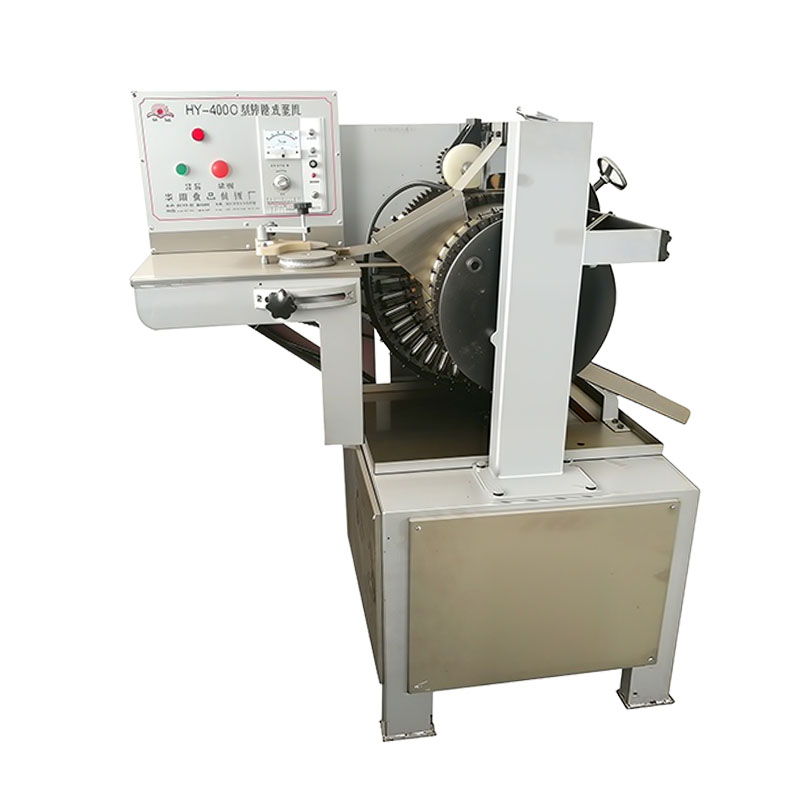
Ball shape forming heads utilize continuous rotary dies. They pinch the sugar rope and insert sticks simultaneously. Flat lollipops require different stamping mechanisms. You must ensure the tooling accommodates the precise stick insertion angle required for your specific design.
We strongly advise comparing servo-driven mechanisms against traditional mechanical cams. Mechanical systems rely on physical cams and gears. They offer robust durability but limit precise adjustments during live production. Servo-controlled stick placement provides microscopic precision. It allows operators to adjust insertion depth digitally via an interface. Servos require less physical maintenance, though they demand higher initial software programming expertise.
The forming head never operates in isolation. It actively dictates requirements for your rope sizers, batch rollers, and subsequent cooling tunnels. If your sizing rollers feed sugar rope too slowly, the die head produces underweight lollipops. Precise speed synchronization prevents these costly bottlenecks.
Evaluating specification sheets requires a skeptical eye. You must translate marketing claims into floor-level realities to protect your investment.
Manufacturer claims stating "up to 1,000 pcs/min" often represent theoretical maximums under perfect laboratory conditions. You must interpret these claims carefully. Realize that formulation viscosity and cooling capacity heavily dictate actual operational speeds. If your cooling tunnel cannot chill 1,000 pieces per minute adequately, the lollipops will deform on the outfeed belt. Always base your calculations on guaranteed OEE rather than theoretical maximums.
Heavy-duty construction ensures longevity. Specify strict requirements for 304 or 316L stainless steel on all product-contact areas. Sugar is highly abrasive and acidic when flavored. You need washdown-rated motors (IP65 or higher) to withstand aggressive daily sanitation protocols. Furthermore, demand sanitary welds lacking pits or crevices where bacteria might breed.
Standardized PLC systems form the brain of modern equipment. We recommend specifying universally recognized platforms like Siemens or Allen-Bradley. Avoid proprietary, closed-box controllers. Open PLC systems allow your in-house maintenance teams to source replacement parts locally. High-quality HMI panels streamline recipe management, simplify troubleshooting sequences, and drastically reduce costly operator errors.
Evaluate the realistic downtime required to swap mold dies for different lollipop sizes. Traditional bolted assemblies often require multiple tools and hours of manual calibration. Modern equipment features quick-release mechanisms. They allow operators to swap heavy die heads safely within minutes. Fast changeovers keep your line running and maximize daily profitability.
Procurement teams must decide whether to purchase individual machines or invest in a cohesive sweet production line. Each path carries unique risks and operational benefits.
Sourcing the entire line from a single manufacturer ensures protocol synchronization. The vendor engineers the cooking, mixing, forming, cooling, and wrapping modules to communicate flawlessly.
Pros: Single point of accountability. Guaranteed electrical handshakes between machines. Unified HMI interfaces for operators.
Cons: Higher upfront capital expenditure. You rely entirely on one vendor's engineering philosophy for every process step.
Integrating a new confectionery machine into an existing legacy line demands rigorous planning. You face significant risks regarding electrical handshakes and line speed matching. Your new forming unit might output 800 pieces per minute, but your 15-year-old wrapper might cap at 400. You must install adequate buffering conveyors to absorb these speed differentials safely.
Buyers often overlook cooling logistics. A high-speed forming machine will absolutely fail without a proportionally sized, climate-controlled cooling tunnel. Hard candy requires specific thermodynamic cooling curves to prevent crystallization or stickiness. You must verify that the vendor correctly calculates the thermal load of your specific sugar mass before finalizing the tunnel dimensions.
Line Integration Risk Matrix | ||
Integration Type | Primary Risk Factor | Mitigation Strategy |
|---|---|---|
Turnkey Full Line | High initial dependency on single vendor. | Require strict FAT across the entire assembled line prior to shipment. |
Standalone Forming Unit | Speed mismatch with legacy wrappers. | Install surge hoppers or upgrade wrapper infeed logic. |
Cooling Tunnel Retrofit | Inadequate ambient climate control. | Install dedicated dehumidification units for the packaging room. |
A machine is only as reliable as the company engineering it. Thoroughly vet your manufacturer to secure your operational future.
Never bypass Factory Acceptance Testing (FAT). The FAT serves as your non-negotiable proof of performance. You must insist on running the machine at the vendor's facility using your actual syrup formulation and your exact sticks. Testing with generic materials hides feed issues and viscosity incompatibilities. Document every test run meticulously.
Ensure the manufacturer adheres to global safety standards. Verify their CE marks for European compliance or UL/CSA certifications for North American electrical safety. Look for ISO 9001 compliance, which indicates rigorous internal quality control processes. Request material certificates verifying FDA-compliant contact parts.
Assess the manufacturer's spare parts inventory and guaranteed response times. You need localized technical support to prevent catastrophic production delays. Ask about the availability of field technicians for Site Acceptance Testing (SAT) and final commissioning at your facility. A vendor lacking robust post-sale support becomes a massive liability during peak production seasons.
Request case studies or references from operational plants featuring similar capacity demands. Contact these references directly. Ask them about the machine's true OEE, the frequency of unscheduled breakdowns, and the vendor's responsiveness during emergencies. Real-world feedback always outperforms polished marketing brochures.
Successfully upgrading your production line requires a paradigm shift. You must move away from simple feature-shopping and embrace outcome-based equipment procurement. By prioritizing OEE, rigorous testing, and seamless line integration, you secure long-term operational stability.
To begin your procurement journey effectively, follow these actionable next steps:
Compile Formulation Data: Document your exact syrup viscosities, operating temperatures, and stick dimensions.
Finalize Target Throughput: Establish hard numbers for required pieces per minute and acceptable defect rates.
Map the Facility Floor Plan: Measure your available footprint, ensuring adequate space for cooling tunnels and maintenance access.
Request Technical Datasheets: Contact shortlisted vendors to request detailed CAD layouts and formal FAT protocols.
A: Realistic timelines typically span 60 to 120 days. This duration accounts for custom engineering, precision machining, assembly, and rigorous factory testing. Complex turnkey lines or specialized servo configurations may push lead times closer to the 150-day mark.
A: Generally, no. While some mainframes adapt to different dies, the physical forming mechanism differs fundamentally. Spherical lollipops utilize continuous rotary dies, whereas flat lollipops require precise stamping and pressing mold sets to shape the product and secure the stick properly.
A: Industrial machines require robust infrastructure. You will need a reliable three-phase electrical power supply, clean compressed air for pneumatic components, and chilled water lines to regulate the temperature of the forming dies and cooling tunnels.
A: Modern systems utilize web recycling capabilities and edge-trim recovery loops. The equipment automatically catches excess sugar rope trimmed during the die-forming phase. It then routes this clean scrap back into the initial melting or batching phase, drastically reducing material waste.
