


Views: 0 Author: Site Editor Publish Time: 2026-01-07 Origin: Site


Moving from a home kitchen or small cottage setup to a commercial production line is a capital-intensive leap. The search for the "best bakery machine" is often misleading—there is no single device that excels at both delicate cake batters and high-hydration sourdoughs. Success lies in selecting an equipment ecosystem that matches your specific hydration levels, production volume, and labor constraints. Relying on a single piece of equipment to handle every task often leads to premature mechanical failure and inconsistent product quality. This guide deconstructs the core machinery categories—mixing, forming, and baking—to help you evaluate options based on ROI, durability, and product quality rather than brand hype. By understanding the mechanical limitations and strengths of different systems, you can build a production line that supports your growth rather than hindering it.
Match Mixer to Matrix: Use Planetary mixers for cakes and versatile batters; use Spiral mixers strictly for bread and heavy dough development.
Oven Type Dictates Crust: Deck ovens are non-negotiable for artisan crusts; Rack ovens offer the best scalability for high-volume consistent baking.
Automation ROI: Bread forming machines and depositors provide the fastest ROI by reducing skilled labor dependencies, not just increasing speed.
Infrastructure First: Never purchase equipment without verifying 3-phase power availability and door clearance—common and costly post-purchase oversights.
New commercial bakers often look for a "Swiss Army Knife" solution—one machine that can mix sourdough in the morning and whip meringue in the afternoon. In a commercial environment, these "combo" machines frequently fail. They cannot handle the sustained torque requirements of heavy doughs while maintaining the high-speed precision needed for aeration.
You must distinguish between an Artisan/Retail profile and a Wholesale/Commissary profile. Retail bakeries typically produce high variety but lower volume per batch. They value versatility. Wholesale operations produce low variety but require massive throughput. They value durability and consistency.
General-purpose bakery machines designed for versatility often compromise on structural integrity. A mixer designed to whip cream effectively relies on high RPM (revolutions per minute) and lower torque. Conversely, developing gluten in a stiff bagel dough requires low RPM and immense torque. Using a high-speed machine for heavy dough burns out motors and strips gears. You must define your primary product matrix before signing a purchase order.
The physics of your dough dictates your machinery requirements. Ignoring hydration levels is the primary reason for equipment failure in the first year of operation.
Cake & Pastry: These products require gentle folding and rapid aeration. The machinery must introduce air bubbles without over-developing gluten, which leads to tough textures. This process demands high RPM and specialized attachments like whisks and paddles.
Bread & Pizza: These doughs act as a resistor. They fight back against the machine. Developing the gluten network requires intensive kneading force. Machinery here needs heavy-duty motors, chain drives, and low RPM to prevent the dough from overheating due to friction.
Before analyzing specifications, look at your facility. Footprint analysis is critical. Vertical equipment, like rack ovens, utilizes ceiling height, whereas deck ovens consume valuable floor space horizontally.
Utility constraints are equally expensive to ignore. Many heavy-duty European machines require 208V or 480V 3-phase power. If your facility only has 220V single-phase power, the electrical upgrade costs can exceed the price of the machine itself. Always verify your voltage and phase capacity. Additionally, measure your doorways. It is a common tragedy for a bakery to buy a fully welded oven only to realize it cannot fit through the delivery entrance.
The heart of the bakery is the mixer. Choosing the wrong type is the most common error in production planning. We break down the two primary categories below.
| Feature | Planetary Mixer | Spiral Mixer |
|---|---|---|
| Primary Mechanism | Agitator moves around a stationary bowl (like a planet). | Bowl rotates while the spiral hook spins. |
| Best Application | Cakes, batters, frostings, cookies. | Bread, pizza, bagels, high-hydration dough. |
| Friction Heat | High (can overheat bread dough). | Low (keeps dough cool). |
| Versatility | High (multiple attachments). | Low (dough only). |
If your menu focuses on sponges, batters, meringues, frostings, and light cookie doughs, the Planetary mixer is your workhorse. It is the quintessential cake making machine. The defining feature is the attachment ecosystem. You can switch from a whisk for egg whites to a paddle for creaming butter and sugar, and then to a hook for a light brioche.
When evaluating these machines, prioritize the bowl lift mechanism. On smaller models, a manual lever is fine. However, once you exceed 60 quarts, an electric bowl lift is a safety necessity to prevent back injuries.
Warning: Be cautious about gear stripping. Many commercial kitchens attempt to use planetary mixers for stiff pizza dough. While the machine might physically rotate, the internal gears (often plastic or brass in cheaper models) will shear off under the resistance. If you see a "Pro" mixer from a residential brand failing in a commercial setting, it is usually because it was overloaded with stiff dough.
For artisan bread, bagels, pizza dough, and high-hydration ciabatta, the Spiral mixer is superior. In this system, the bowl rotates while the hook spins. This dual-rotation action kneads the entire dough mass efficiently without the "beating" action of a planetary mixer.
The primary advantage is temperature control. Friction generates heat, and heat kills yeast activity prematurely. Spiral mixers minimize friction, keeping your dough cool during long mixing cycles. When selecting a spiral mixer, look for two-speed capability. You need a slow speed for incorporating ingredients without splashing (flour fly-up) and a fast speed for developing gluten structure. Additionally, a reverse bowl function makes removing 50lbs+ of dough significantly easier, saving your staff from physical strain.
Hand-shaping adds an artisan touch, but it creates a bottleneck as you scale. Consistency suffers as fatigue sets in. Automating this stage is often a financial necessity.
To justify the cost, calculate your "Labor-Cost-Per-Loaf." If a skilled baker takes 2 minutes to weigh and shape a baguette, and they earn $20/hour, that cost adds up quickly over 500 loaves. Automation equipment reduces this time to seconds. The goal is not just speed; it is about freeing up your skilled staff to focus on fermentation management and finishing, where their expertise truly adds value.
Accuracy in portioning is vital for profit margins. Over-scaling by just 10 grams per loaf can cost thousands of dollars in lost flour over a year.
Hydraulic Dividers: These are essential for high-hydration or fermented doughs. Unlike mechanical dividers that punish the dough, hydraulic systems exert even pressure, dividing the batch without degassing your sensitive sourdough structure.
Moulders/Sheeters: Once divided, the dough needs shaping. A bread forming machine (often called a moulder) rolls the dough into tight logs for loaves or baguettes. It impacts the crumb structure by standardizing the air pockets. Note the distinction: A "dough sheeter" is mandatory for croissants and pastry lamination, creating thin layers of butter and dough. A "moulder" is used for shaping loaves. While they look similar, their functions are distinct.
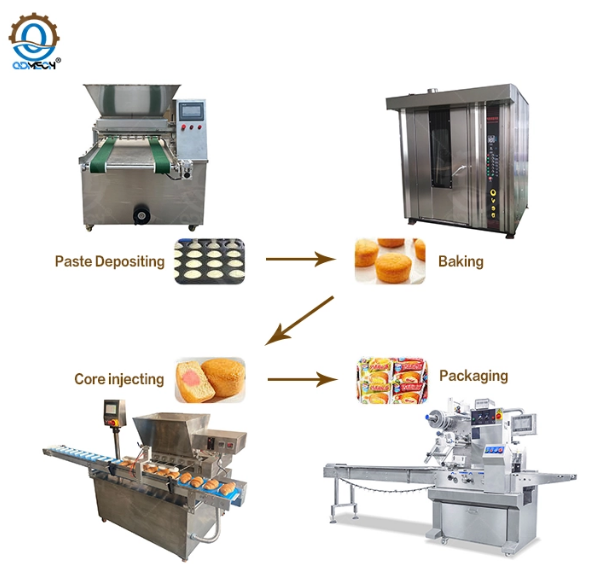
In the realm of batter, cake making automation focuses on depositing. Piston depositors ensure every cupcake tin or layer cake pan receives the exact same amount of batter. This guarantees even bake times. If pans have varying amounts of batter, the smaller ones will burn while the larger ones remain raw in the center.
For stiffer products like cookies, you need high-torque wire-cut machines (cookie droppers). These machines extrude dough through a die and slice it with a wire. Standard depositors cannot handle the stiffness of chilled cookie dough; you need specialized equipment to handle the pressure.
The oven is the most expensive and permanent fixture in your bakery. It dictates the quality of your crust and the volume of your output.
For crusty hearth breads, baguettes, and traditional pizza, the deck oven is the gold standard. It operates on conduction heat. The dough sits directly on a hot stone hearth. This direct contact drives heat into the loaf, creating "oven spring" (rapid expansion) and a thick, crispy bottom crust.
The critical feature to evaluate is the Steam Injection System. Artisan crusts require a blast of steam in the first few seconds of baking to keep the surface moist, allowing the loaf to expand before the crust hardens. Compare integrated steam generators against manual gravity-fed systems. Integrated systems provide consistent, powerful bursts essential for that glossy finish.
Recovery time is also vital. When you load cold dough onto the hot stone, the stone's temperature drops. A high-quality bread oven has thick stones (thermal mass) that retain heat, allowing you to bake batch after batch without waiting for the oven to reheat.
Rack and convection ovens use fans to circulate hot air. This is convection heat. They are best for cookies, cakes, pastries, and soft buns where even browning is preferred over a hard bottom crust.
The main advantage is scalability. You can prepare entire racks of product and roll them directly into the oven. This saves immense labor compared to loading a deck oven one loaf at a time. However, the moving air can dry out products. For delicate items like soufflés, sponges, or macarons, you need an oven with a "low velocity" fan setting to prevent the batter from being blown sideways or drying out prematurely.
Many bakeries attempt to use one oven for both pizza and bread. While possible, temperature ranges differ. A dedicated pizza/bread oven hybrid must reach 700°F+ for Neapolitan styles, whereas bread typically bakes under 500°F.
The trade-off lies in insulation. A pizza oven needs to recover heat instantly after a 90-second bake. A bread oven focuses on steady, long-term heat retention. If you choose a hybrid, ensure the insulation quality is high enough to maintain stability during the constant door-opening of pizza service.
Total Cost of Ownership (TCO) extends far beyond the sticker price. Implementation headaches and maintenance downtime can bankrupt a new bakery.
Your equipment must pass local health inspections. Look for NSF or ETL certification stamps. Beyond the sticker, check the cleanability. Can you disassemble the hoppers and blades without tools? "Tool-free" disassembly is critical for allergen control. If a cleaner needs a screwdriver to wash a bread forming machine, they will likely skip cleaning the difficult parts, leading to mold buildup or cross-contamination.
Be wary of "White Label" imported machinery that lacks a domestic parts inventory. If a control board fails, waiting six weeks for a shipment from overseas stops your production cold. Standardizing your brands can simplify service contracts. If your mixer, oven, and sheeter share similar electronic components or are serviced by the same local technician, you reduce your administrative burden during a crisis.
Finally, consider the operating costs. Gas ovens generally offer cheaper operational costs in many regions compared to electric ones, but they require expensive ventilation hoods. Electric ovens are easier to install but can spike your utility bill. Check the insulation quality by touching the exterior of the oven while it is running. If it is hot to the touch, you are paying to heat your kitchen, not your bread. Good insulation keeps the heat inside the chamber, saving money and keeping your bakers comfortable.
The "best" bakery machine is not the one with the most digital features, but the one that survives your daily production reality. For cake production, a high-quality planetary mixer and convection oven are the entry stakes. For bread, investment in a spiral mixer and a steam-injected deck oven is the only path to professional crust and crumb. Prioritize equipment with proven heavy-duty cycles and available local service support to protect your bakery’s continuity.
A: A dough sheeter is a large floor machine used to laminate dough for pastries like croissants and danishes. It thins the dough gradually over multiple passes. A dough roller is typically a smaller countertop unit used to flatten a single piece of dough into a circle or oval, primarily for pizza bases, tortillas, or fondant. Sheeters are for layers; rollers are for shape.
A: Yes, but crust development will suffer without steam injection and radiant heat from a deck; results will be more like "soft" bread. The fan in a convection oven dries the surface too quickly, preventing the full expansion (oven spring) needed for rustic loaves. You will get a uniform crust rather than the complex, blistered crust of a hearth loaf.
A: Mixers (mechanical) are safer used bets than ovens (electronic/thermostat issues). Always inspect gearboxes for leaks and noises. Mechanical devices like mixers or slicers are easier to repair. Ovens, especially modern ones with digital panels and sensors, can have hidden electronic faults that are expensive to diagnose and fix.
A: Highly recommended for managing inventory, rapidly cooling fillings for food safety, and batch-producing frozen doughs. A blast chiller allows you to stabilize products quickly, preventing bacterial growth in custards and allowing you to freeze raw pastries without forming large ice crystals, preserving the texture upon baking.
