


Views: 0 Author: Site Editor Publish Time: 2026-02-23 Origin: Site


The restaurant industry is currently witnessing a significant operational shift. More owners are moving away from purchasing wholesale fresh noodles and are instead bringing production in-house to strictly control food costs and texture quality. However, making this transition requires navigating a complex equipment market. It is crucial to distinguish immediately between "prosumer" gadgets—like tabletop attachments that burn out under commercial loads—and robust commercial noodle machines capable of sustaining rigorous restaurant service.
This decision represents more than just a hardware purchase; it is a fundamental change in how your kitchen operates. You are effectively balancing upfront capital expenditure (CapEx) against long-term savings on the Cost of Goods Sold (COGS) and labor efficiency. By automating the most repetitive parts of dough preparation, kitchens can achieve higher consistency and lower recurring costs. In this guide, we explore the financial logic, technical differences, and operational realities of investing in professional noodle production equipment.
Volume Thresholds: Why 200–400 portions per day is the critical "break-even" point for upgrading from manual/mixer combos to fully automatic units.
Texture Physics: The critical difference between Extruders (dense, pasta-style) and Sheeters/Laminators (chewy, ramen/udon style).
The Tiered Market: Understanding the gap between budget direct-imports ($500–$1,000) and premium "noodle ecosystems" ($20,000+).
Labor Impact: How automation shifts staff focus from repetitive rolling to high-value prep, rather than eliminating staff entirely.
Before discussing horsepower or die shapes, you must evaluate the financial viability of on-site production. The argument for automation rarely relies on convenience alone; it relies on hard mathematics regarding cost per serving and customer retention.
The price gap between raw ingredients and a finished wholesale product is where your profit lies. Flour and water are pennies on the dollar compared to the markup charged by artisan noodle suppliers. For a standard ramen shop, the cost of purchasing high-quality fresh noodles might hover between $0.50 and $0.80 per portion. In contrast, the raw material cost for house-made noodles often sits below $0.15.
If your venue serves 200 bowls a day, saving $0.40 per portion equates to $80 daily, or roughly $24,000 annually. This savings trajectory creates a calculable "payback period." For a mid-range machine costing $8,000, the equipment pays for itself in roughly four months of operation at that volume. Even at lower volumes, such as 50kg of dough per day, the ROI becomes visible within the first fiscal year.
Inconsistent food kills restaurant brands. Manual rolling or using underpowered equipment introduces human error. The thickness of a noodle determines its cooking time and mouthfeel. If a prep cook rolls dough slightly thicker on a Tuesday morning than on a Friday night, the boil times will be wrong, and the customer experience will suffer.
Automatic machinery eliminates this variance. By locking in calibration settings, you ensure that every strand is identical to the last. This consistency allows you to standardize cooking procedures, ensuring that a bowl of noodles served during a lunch rush tastes exactly the same as one served at closing time.
Relying on third-party suppliers introduces external risks. Delivery trucks break down, suppliers raise prices without notice, and quality can fluctuate based on their staffing issues. Bringing production in-house mitigates these risks. You are no longer beholden to a delivery schedule. Furthermore, printing "House-Made Noodles" on a menu carries significant marketing weight. It signals freshness and craftsmanship to the consumer, often justifying a higher menu price point that further accelerates the return on your investment.
Not all machines produce the same noodle. The texture of your final product—whether it is a bouncy ramen, a dense spaghetti, or a soft udon—depends entirely on the mechanical physics used to form the dough.
Extrusion is the standard method for Italian pasta production. These machines work by forcing dough through a metal die (mold) under immense pressure. An internal screw pushes the mixture forward, compressing it until it exits the machine in the desired shape.
This method is unbeatable for round shapes like spaghetti or hollow shapes like macaroni and penne. It offers high-volume consistency and speed. However, there are trade-offs. The high pressure generates heat, which can cook the proteins slightly if the machine is not cooled properly, potentially degrading the texture. Additionally, extruded noodles tend to have a denser bite compared to rolled noodles.
For Asian-style noodles like Ramen, Udon, or Soba, sheeting is the preferred technology. These machines press dough between heavy rollers to form a flat sheet. The sheet is often folded and rolled multiple times—a process called lamination—to develop the gluten network. Once the sheet reaches the desired thickness, it passes through a cutter.
This mechanism mimics hand-rolling, preserving the gluten structure to create a "chewy" or springy texture. Interestingly, this technology often overlaps with bakery pastry equipment. Restaurants that produce their own breads, croissants, or dumpling wrappers often find that a high-quality sheeter offers crossover utility, maximizing the equipment's value across the entire menu.
Space-constrained kitchens often opt for a hybrid workflow. Instead of buying a massive all-in-one floor unit, they utilize a heavy-duty commercial spiral mixer to handle the hydration and initial dough formation. Once the crumbly dough is ready, it is transferred to a standalone benchtop press or cutter.
This strategy separates the processes, allowing for parallel workflows. While one staff member mixes the next batch, another can be cutting noodles. It is an ideal strategic fit for kitchens with limited footprints or budget constraints, offering commercial durability without the price tag of fully automated ecosystems.
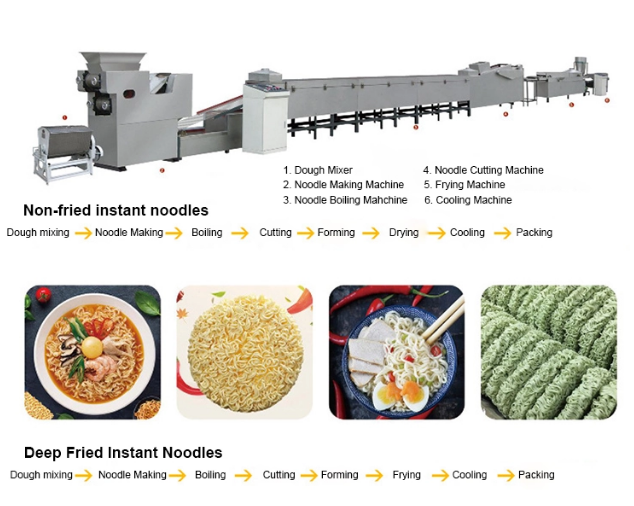
The market for noodle machinery is vast, ranging from affordable imports to luxury systems. Understanding the tiers helps you match the machine to your business model.
| Market Tier | Price Range | Throughput | Best Fit For |
|---|---|---|---|
| Tier 1: The Budget Workhorse | $300 – $1,000 | 25–40kg/hr | Small dumpling shops, food stalls, or low-volume concepts testing the market. |
| Tier 2: The Distributor Standard | $2,000 – $8,000 | 50–100kg/hr | Busy Italian restaurants, established ramen shops, and high-turnover casual dining. |
| Tier 3: The Premium Solution | $15,000 – $40,000+ | 100kg+/hr | High-end specialty franchises, central kitchens, and texture-obsessed brands. |
These units are typically direct imports featuring simple electric motors and basic steel construction. They offer high value for startups with limited capital. However, they usually lack advanced safety sensors (like automatic shut-offs when guards are lifted) and refined thickness controls. Support is often minimal, meaning you are on your own for repairs.
In this range, you find machines built with NSF/UL certifications, which are crucial for passing health inspections in the US and EU. Construction is durable stainless steel, and parts are standardized. If a gear strips or a belt snaps, you can order a replacement locally. Ideally suited for busy restaurants, these machines offer consistent daily output without the fear of sudden downtime.
These are not just machines; they are production labs. They include built-in hydration mixers, automatic dusting systems to prevent sticking, and computerized recipe storage for different dough types. Manufacturers at this level often provide "Noodle Schools" and consulting to help you develop proprietary recipes. This tier is for businesses where the noodle texture is the brand’s primary differentiator.
Buying the machine is the easy part; integrating it into a working kitchen requires foresight.
Space is a premium ingredient in any kitchen. Countertop models save floor space but may disrupt prep flow if they require constant movement. Floor models are stationary beasts that command their own station. You must also verify voltage. Many commercial units, especially those designed for stiff, low-hydration doughs, require 220V or even 3-Phase power. Plugging a heavy-duty machine into a standard 110V outlet is a recipe for tripped breakers and burnt motors.
Flour dust is the enemy of electronics and sanitation. You must assess how much "flour cloud" a machine generates. Does it have an enclosure? Furthermore, look at the disassembly process. If a machine takes one hour to take apart and clean properly, your staff will eventually stop cleaning it thoroughly, leading to sanitation risks or mechanical failure. The best machines feature tool-free disassembly for rapid end-of-shift cleaning.
Automation shifts the skill requirement from "chef intuition" to "machine calibration." Staff do not need to know how to hand-pull noodles, but they must learn how to dial in the roller gaps and monitor hydration levels. Safety is paramount. These machines use high-torque motors and heavy rollers. Training protocols must strictly cover guard rails and the location of emergency stop buttons to prevent injuries.
Use this decision matrix to shortlist your options before contacting suppliers.
Output Requirement: Be realistic about your peak hours. Do you need 50 portions per hour or 500? Oversizing wastes capital, but undersizing a machine causes you to run it continuously at max capacity, which burns out motors. For industrial-scale needs, you might even consider a comprehensive noodle making machine line rather than a standalone unit.
Hydration Capability: Water content defines dough stiffness. Ramen dough is very dry (low hydration) and hard to press; Udon is wet and soft. Ensure the machine is rated for your specific dough stiffness. Using a machine designed for soft pasta to press dry ramen dough will strip the gears.
Versatility: Will you change shapes mid-shift? Some machines feature quick-change dies that swap out in seconds. Others require unbolting entire cutter assemblies, which kills momentum during service.
Serviceability: When the machine breaks—and it is a question of when, not if—who fixes it? Is there a local technician, or will you be troubleshooting via video call with a manufacturer in a different time zone?
Automating your noodle production offers a strategic advantage that goes beyond simple cost savings. It provides the consistency necessary to scale a brand and the independence to control your supply chain. By moving from manual labor or supplier contracts to in-house automation, you transform a variable cost into a fixed asset.
For most restaurants, the journey starts with a modular approach—perhaps a high-quality mixer and a reliable tabletop sheeter. As volumes grow past the critical 200-portion mark, investing in an all-in-one ecosystem becomes the logical next step. Choose the technology that matches your noodle style, verify your volume requirements, and treat the purchase as a long-term operational partnership.
A: For a restaurant serving 200 portions daily, the savings on food costs (vs. buying wholesale fresh noodles) typically pay for a mid-range ($5,000–$8,000) machine in 4 to 6 months. Lower volume shops generally see a return on investment within 12 to 18 months.
A: Yes, specifically for rolled noodles like Udon or flat wide noodles. Bakery sheeters are excellent for laminating dough to develop gluten. However, you will still need a separate cutter or manual knife work to slice the sheets into strands.
A: Extruders push dough through a die, creating round or hollow shapes (spaghetti, macaroni) with a denser texture. Noodle presses (sheeters) roll the dough flat and cut it, preserving a chewy, springy texture ideal for Ramen and Asian styles.
A: Choose machines with tool-free disassembly and stainless steel contact parts. Establish a strict protocol where staff disassemble and dry-clean (brush/vacuum) flour residue daily, and wash removable parts with sanitizer. Never use water on the motor housing.
A: No. The benefit of commercial machines is that they standardize the process. Once the recipe and machine settings are calibrated, a general prep cook can operate the machine with minimal training, replacing the need for a highly paid artisan specialist.
